
Obesity: A Modern, Multifactorial Epidemic New Blog Post
Obesity: A Modern, Multifactorial Epidemic
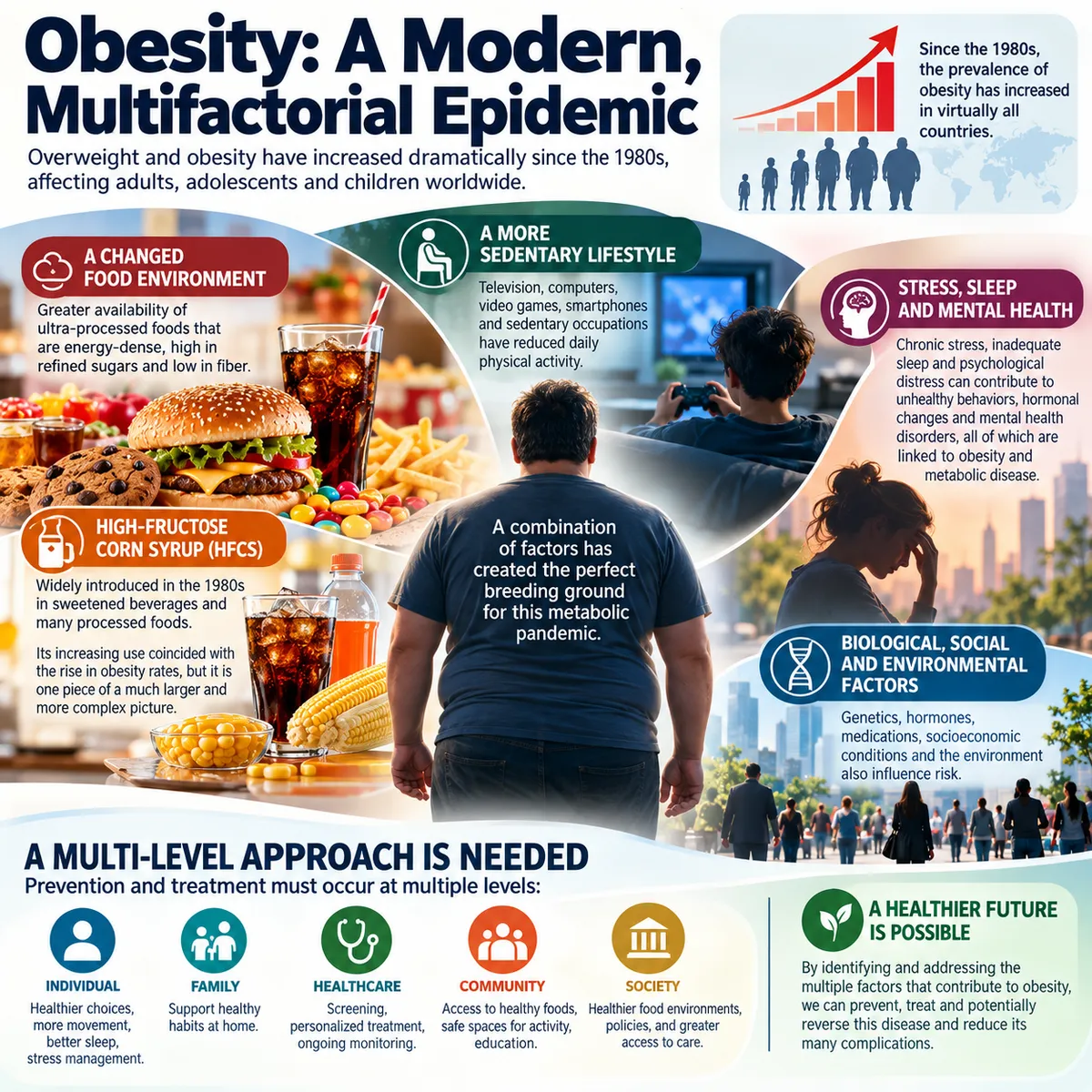
Overweight and obesity have become among the most important public health challenges of the 21st century. Since the 1980s, their prevalence has increased dramatically across much of the world, affecting adults, adolescents, and children.
This rise has occurred alongside profound changes in our food environment and daily lifestyles.
The expansion of the modern food industry has made highly palatable, energy-dense, ultra-processed foods increasingly accessible. Many of these products contain refined carbohydrates and added sugars while providing relatively little fiber and satiety.
One notable change was the widespread introduction of high-fructose corn syrup (HFCS) into sugar-sweetened beverages and many processed foods. Its increasing use occurred during the same decades in which obesity rates accelerated. However, this temporal association should not be interpreted as proof that HFCS alone caused the obesity epidemic. Rather, it represents one component of a much larger transformation of our food environment and patterns of energy consumption.
At the same time, our daily energy expenditure has changed.
Television, computers, video games, smartphones, transportation, and increasingly sedentary occupations have reduced the need for routine physical activity. This is particularly relevant for children, adolescents, and young adults, who are growing up in an environment in which prolonged sitting and screen time can easily become the norm.
Add chronic stress, inadequate sleep, psychological distress, and social and environmental pressures, and the picture becomes even more complex.
Obesity should therefore not be reduced to a simple equation of “eat less and move more.” It is a chronic, multifactorial disease involving interactions among nutrition, physical activity, genetics, neurohormonal regulation, metabolism, sleep, stress, medications, mental health, socioeconomic factors, and the environment.
Understanding these drivers matters because prevention and treatment must occur at multiple levels: individual, family, healthcare, community, and society.
If we can identify the factors contributing to obesity in each person and population, we can intervene earlier, personalize treatment, monitor metabolic health, and potentially prevent or improve many obesity-related complications.
The obesity epidemic did not arise from a single cause—and it will not be solved with a single intervention.
Better food environments. More daily movement. Better sleep. Stress management. Earlier metabolic screening. Evidence-based obesity treatment. And greater access to care.
That is the comprehensive approach this complex disease requires.
Al W. Robaina, MD, ABIM, DABOM