
Adiposopathy Dysmetabolic Disease (ADD): A Proposed Framework for Metabolic Dysfunction
Adiposopathy Dysmetabolic Disease (ADD):
A Proposed Causally-Descriptive Term for Adiposity-Driven Metabolic Dysfunction
Abstract
Background: Multiple terms have been used to describe the cluster of metabolic abnormalities associated with obesity, including Syndrome X, Metabolic Syndrome, and, more recently, Cardiovascular-Kidney-Metabolic (CKM) disease. While these terms describe the clinical presentation, none explicitly names the underlying causal driver: dysfunctional adipose tissue, or adiposopathy.
Objective: To propose Adiposopathy Dysmetabolic Disease (ADD) as a new term that names both the origin (adiposopathy) and the clinical nature (dysmetabolic dysfunction) of this group of conditions, and to propose corresponding diagnostic criteria.
Methods: Diagnostic criteria were developed using established, individually validated clinical thresholds, structured to parallel the ATP III Metabolic Syndrome model. ADD is defined by the presence of adiposity (BMI ≥25 kg/m², or ≥23 kg/m² in individuals of Asian ethnicity; or waist circumference >40 in men / >35 in women) plus any two of six criteria: HbA1c ≥5.7%, HOMA-IR ≥2.5, fasting blood glucose ≥99 mg/dL, HDL <40/<50 mg/dL, triglycerides ≥150 mg/dL, or blood pressure ≥130/85 mmHg. Hepatic and renal markers (AST/ALT, hepatic steatosis, microalbuminuria) are included as supportive, non-required findings.
Discussion: ADD is proposed as a terminologically explicit complement to existing frameworks, intended to improve clinical communication and education by directly linking adipose tissue dysfunction to its downstream metabolic consequences. Validation of the proposed criteria as a unified diagnostic entity is an important direction for future research.
Conclusion: Adiposopathy Dysmetabolic Disease (ADD) offers a causally descriptive alternative to existing terminology, with potential value in clinical teaching, communication, and future research classification.
Introduction
Multiple terms have been used in the past to define a cluster of factors and conditions that share a common denominator: metabolic dysfunction. Syndrome X was among the earliest, used to describe individuals with obesity at high risk for diabetes. This evolved into Metabolic Syndrome following the ATP III criteria, which defined five elements and required a minimum of three to fulfill the diagnosis. More recently, the AHA/ACC expanded this complexity and clinical scope with the introduction of Cardiovascular-Kidney-Metabolic (CKM) syndrome, incorporating kidney disease into the framework.
Other authors have implied a relationship between obesity and these related conditions. Bays, for example, coined “adiposopathy-related diabetes” as a synonym for diabesity, and “adiposopathy-related conditions” more broadly.
Building on this lineage, we propose a new term that, in our view, more directly captures the root of the problem and its causal-effect nature: Adiposopathy Dysmetabolic Related Disease, or simply Adiposopathy Dysmetabolic Disease (ADD). This term is intended to encompass the range of conditions known to be connected to increased adipose tissue and its direct toxic effects.
Definition and Diagnostic Criteria
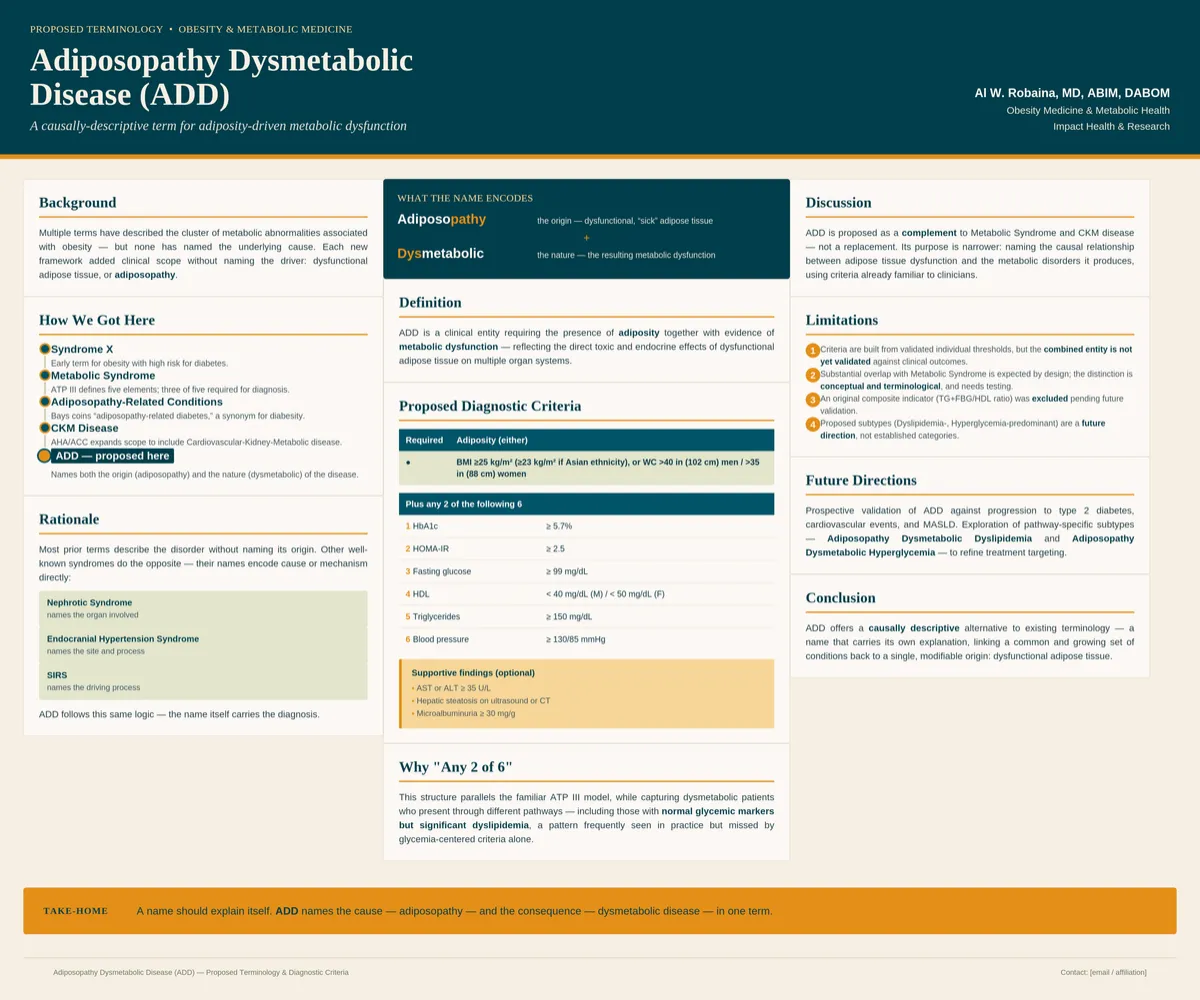
We define Adiposopathy Dysmetabolic Disease (ADD) as a clinical entity requiring the presence of adiposity together with evidence of metabolic dysfunction, reflecting the direct toxic and endocrine effects of dysfunctional adipose tissue on multiple organ systems.
Required: Adiposity (either) | Plus any 2 of the following 6 |
BMI ≥25 kg/m² (≥23 kg/m² if Asian ethnicity), or WC >40 in (102 cm) men / >35 in (88 cm) women | 1. HbA1c ≥5.7% 2. HOMA-IR ≥2.5 3. Fasting blood glucose ≥99 mg/dL 4. HDL <40 mg/dL (men) / <50 mg/dL (women) 5. Triglycerides ≥150 mg/dL 6. Blood pressure ≥130/85 mmHg |
Supportive findings (optional, not required for diagnosis) |
•AST or ALT ≥35 U/L •Hepatic steatosis on ultrasound or CT •Microalbuminuria ≥30 mg/g |
This “any two of six” structure deliberately parallels the ATP III model for Metabolic Syndrome, allowing ADD to be recognized within a familiar diagnostic framework while capturing patients whose dysmetabolic phenotype may present through different pathways — for example, individuals with normal glycemic markers but significant dyslipidemia, a pattern frequently observed in clinical practice yet not always captured by glycemia-centered criteria alone.
These supportive markers extend the clinical picture of ADD beyond the traditional cardiometabolic axis, capturing early hepatic and renal involvement — consistent with the broader, multi-organ toxic effects of adiposopathy that this term is intended to describe.
Rationale
Most terms used previously to describe this cluster of conditions are descriptive of the disorder itself rather than of its origin. Metabolic Syndrome, for instance, does not name the underlying cause — the connection between excess adipose tissue and the disease process it produces is left implicit rather than stated in the term.
This stands in contrast to many other well-recognized syndromes (setting aside those defined by eponyms), where the name itself points to the origin or mechanism of the disorder. Endocranial Hypertension Syndrome names the site and the process. Nephrotic Syndrome names the organ involved. Systemic Inflammatory Response Syndrome (SIRS) names the underlying process driving the condition. In each case, the name carries diagnostic and conceptual information beyond a simple label.
The terminology proposed here follows this same principle. Adiposopathy Dysmetabolic Disease is intended to name both elements at once: adiposopathy, the origin — dysfunctional, “sick” adipose tissue — and dysmetabolic, the nature of the resulting disorder. Rather than describing a constellation of findings without reference to cause, ADD is built to communicate the causal relationship directly in its name: adipose tissue dysfunction as the driver, and dysmetabolic disease as its clinical expression.
This structure also allows for future refinement. As adiposopathy can express itself through different dominant pathways, ADD may eventually be further differentiated into subtypes — for example, Adiposopathy Dysmetabolic Dyslipidemia or Adiposopathy Dysmetabolic Hyperglycemia — to describe patients whose dysmetabolic presentation is driven predominantly by one pathway over another, while remaining unified under the same causal framework.
Discussion and Limitations
Adiposopathy Dysmetabolic Disease (ADD) is proposed as a complementary framework, not a replacement for Metabolic Syndrome or the more recently expanded Cardiovascular-Kidney-Metabolic (CKM) framework. Its purpose is narrower and more specific: to name the causal relationship between adipose tissue dysfunction and the downstream metabolic disorders it produces, using diagnostic criteria familiar to clinicians already applying Metabolic Syndrome in practice.
Several limitations should be acknowledged. First, the proposed criteria — while built from established, individually validated thresholds — have not themselves been validated as a combined diagnostic entity. Prospective studies will be needed to assess how ADD, as defined here, correlates with clinical outcomes such as progression to type 2 diabetes, cardiovascular events, or MASLD, and whether it identifies patients differently than existing Metabolic Syndrome or CKM criteria.
Second, the overlap between ADD and Metabolic Syndrome is substantial by design, since both draw on similar underlying pathophysiology. The distinction being proposed is conceptual and terminological — naming the causal origin — rather than a claim that ADD identifies a clinically distinct population. This distinction will need to be tested rather than assumed.
Third, the original composite indicator considered during development of this framework (TG+FBG/HDL ratio) was deliberately excluded from the final diagnostic criteria, as it has not yet been validated. It remains a candidate for future research rather than part of the proposed diagnostic definition.
Finally, the proposed subtypes (e.g., Adiposopathy Dysmetabolic Dyslipidemia, Adiposopathy Dysmetabolic Hyperglycemia) are presented as a conceptual direction for future work rather than as established categories at this stage.
Despite these limitations, we believe ADD offers value as a teaching and communication tool — a name that carries its own explanation, linking a common and growing set of conditions back to a single, modifiable origin: dysfunctional adipose tissue.
Foundational concepts — insulin resistance
1. Reaven GM. Banting Lecture 1988: Role of insulin resistance in human disease. Diabetes. 1988;37(12):1595-1607.
2. DeFronzo RA. Lilly Lecture 1987: The triumvirate: β-cell, muscle, liver — a collusion responsible for NIDDM. Diabetes. 1988;37(6):667-687.
3. DeFronzo RA. Banting Lecture: From the triumvirate to the ominous octet — a new paradigm for the treatment of type 2 diabetes mellitus. Diabetes. 2009;58(4):773-795.
4. Kahn CR. The Multifaceted Roles of Adipose Tissue — Therapeutic Targets for Diabetes and Beyond: The 2015 Banting Lecture. Diabetes. 2016;65(6):1452-1461.
Metabolic Syndrome — definitions and critique
5. Expert Panel on Detection, Evaluation, and Treatment of High Blood Cholesterol in Adults. Executive Summary of the Third Report of the NCEP Expert Panel (Adult Treatment Panel III). JAMA. 2001;285(19):2486-2497.
6. Grundy SM, Cleeman JI, Daniels SR, et al. Diagnosis and Management of the Metabolic Syndrome: An AHA/NHLBI Scientific Statement. Circulation. 2005;112(17):2735-2752.
7. Alberti KGMM, Zimmet P, Shaw J; IDF Epidemiology Task Force Consensus Group. The metabolic syndrome — a new worldwide definition. Lancet. 2005;366(9491):1059-1062.
8. Kahn R, Buse J, Ferrannini E, Stern M. The metabolic syndrome: time for a critical appraisal. Diabetes Care. 2005;28(9):2289-2304.
Visceral/dysfunctional adiposity
9. Després JP, Lemieux I. Abdominal obesity and metabolic syndrome. Nature. 2006;444(7121):881-887.
Adiposopathy literature (Bays)
10. Bays HE, Abate N, Chandalia M. Adiposopathy: sick fat causes high blood sugar, high blood pressure, and dyslipidemia. Future Cardiol. 2005;1(1):39-59.
11. Bays HE. Is adiposopathy (sick fat) an endocrine disease? Int J Clin Pract. 2008;62(10):1474-1483.
12. Bays HE. Adiposopathy: is "sick fat" a cardiovascular disease? J Am Coll Cardiol. 2011;57(25):2461-2473.
13. Bays HE. Adiposopathy, "sick fat," Ockham's razor, and resolution of the obesity paradox. Curr Atheroscler Rep. 2014;16(5):409.
Adiposopathy-related diabetes (recent)
14. Gorgojo-Martínez JJ. Adipocentric Strategy for the Treatment of Type 2 Diabetes Mellitus. J Clin Med. 2025;14(3):678.
CKM framework (AHA, 2023)
15. Ndumele CE, Rangaswami J, Chow SL, et al. Cardiovascular-Kidney-Metabolic Health: A Presidential Advisory From the American Heart Association. Circulation. 2023;148(20):1606-1635.
16. Ndumele CE, Neeland IJ, Tuttle KR, et al. A Synopsis of the Evidence for the Science and Clinical Management of Cardiovascular-Kidney-Metabolic (CKM) Syndrome: A Scientific Statement From the AHA. Circulation. 2023;148(20):1636-1664.
A note on #8 (Kahn et al.) — it's a well-known critical appraisal of Metabolic Syndrome as a diagnostic construct, useful to cite in your discussion/limitations section since it shows you're engaging with the controversy rather than avoiding it.